
What do the world’s most valuable and reputable brands have in common?
Every brand is, at its core, a relationship with people. It begins with a promise, is tested in every encounter, and is strengthened—or broken—over time. Just like any human bond.
However, we forget this far too often. We talk about targets, impressions, audiences, and funnels. We measure how many people saw us and how many remembered us. And, almost without realizing it, we begin to treat people as spectators of our brands, when in reality they are the protagonists of their own lives. In their lives, brands are merely guests.
People don’t live for brands. They live their lives: they work, learn, take care of themselves, celebrate, worry, and connect with others. And in some of those moments, they let certain brands into their lives. Some out of necessity. Others out of habit. Very few out of affection.
Therefore, the question that defines the future of branding is not how much noise a brand makes. It’s what place each person gives it in their life.
What is Share of Life?
For decades, brands competed to gain space in the media and in the minds of consumers. Brand awareness, advertising recall, and share of voice were key indicators of their competitive ability.
They still are.
But the digital economy forces us to broaden that perspective. Today, a brand can be omnipresent and, at the same time, completely dispensable. It can fill screens and not fill any void in anyone’s life.
I call that space a brand occupies, or doesn’t occupy, Share of Life. Or in Spanish, life-centric brands, but in branding and marketing, almost everything sounds better and cooler in Shakespeare’s language.
In this new dimension, brands have moved from the media space to a place in people’s lives. Branding has to start operating in a scenario for which most were neither ready nor prepared.
Share of Life is the place a brand occupies in people’s daily habits, rituals, decisions, and relationships. Unlike Share of Voice, which measures presence, or Share of Wallet, which measures spending, Share of Life measures real relevance : how noticeable it would be if the brand disappeared.
From Share of Voice to Share of Life: The Five Brand Metrics
To understand where branding is headed, it’s helpful to organize how we’ve measured a brand’s success. Not as indicators that replace each other, but as rungs on the same ladder. Each one answers a different question, and each one, on its own, falls short.
- Share of Voice: how much we’re seen. It measures a brand’s presence in media and conversations compared to its competitors. Its limitation: being seen doesn’t mean being chosen.
- Share of Mind : how much we are remembered. It measures brand awareness and recall. Its limitation: remembering is not the same as wanting.
- Share of Heart: how much they love us. It measures emotional preference, affinity, and connection. Its limitation: loving isn’t always about buying.
- Share of Wallet: how much of their money customers choose us to spend. It measures what portion of a customer’s spending in a category goes to the brand. Its limitation: buying doesn’t always mean belonging.
- Share of Life: how much we matter in their real lives. It measures the place the brand occupies in habits, rituals, and relationships. Its requirement: usefulness, meaning, and consistency.
The ladder leads from noise to meaning. The first rungs are bought with investment. The last ones are only earned through relationships.
Share of Heart: What doesn’t appear in the CFO’s spreadsheet
Share of Heart measures something spreadsheets often ignore: how much affection, admiration, or identification a brand evokes. It’s the difference between a brand that’s used and a brand that’s championed.
A brand with Share of Heart weathers a crisis, a mistake, or a price increase better. People give it the benefit of the doubt. They recommend it without being asked. It’s the realm of what I call believers : people who trust, engage with, and feel that the brand also represents something of their own.
But the heart alone doesn’t pay the bills. There are highly admired brands that almost no one buys. Admiration without business is applause, not a relationship.
Share of Wallet: The Truth About Money
Share of Wallet is more prosaic and therefore more honest. It doesn’t ask how many customers you have, but rather what portion of what your customers spend in your category ends up with you.
It’s an invaluable indicator because it dispels a common misconception: that having someone as a customer means having their preference. Many people are “customers” of several brands at once and distribute their spending based on price, convenience, or habit.
But Share of Wallet also has a catch. It can grow due to convenience, discounts, or a lack of alternatives. And a relationship built solely on convenience lasts exactly as long as the advantage does. As soon as a cheaper or more convenient option appears, the wallet moves without asking the heart’s permission.
That’s why Heart and Wallet need each other. Share of Wallet without Share of Heart is a relationship of convenience. Share of Heart without Share of Wallet is admiration without business. When they meet, something deeper begins to emerge.
Examples of Share of Life
Some brands haven’t built their growth solely by increasing their advertising investment. They’ve managed to integrate themselves into cultural and social practices that are part of the lives of millions of people.
YouTube has evolved from a video distribution platform into an ecosystem where entertainment, learning, creation, information, communities, and economic activity coexist. Its creators don’t just generate content. They build relationships with their audiences, develop businesses, influence consumer decisions, and create value for other brands. YouTube is the place we go to learn how to fix a faucet, listen to music, understand the news, or simply pass the time.
Spotify accompanies specific moments of the day: the commute, workouts, concentration, parties, relaxation. Many of its playlists aren’t organized by genre, but by life situations. And every December, it transforms a year’s worth of listening into a shared ritual with Wrapped , where millions of people showcase what they’ve listened to, like revealing a part of their identity. Few brands have managed to make their own data report feel like a celebration.
Netflix quickly understood that its competition isn’t limited to other streaming platforms. It competes for people’s time, interest, and cultural engagement. Its co-founder, Reed Hastings, summed it up provocatively in 2017: its biggest competitor was sleep. Its expansion into live experiences, sports, and video games reflects its search for new forms of relevance.
The three cases present different models, but reveal the same strategic ambition: to move from being a consumer option to becoming a recurring presence in everyday behaviors. They’re not just fighting for a voice, a mind, a heart, or a wallet. They’re fighting for a place in our routines.
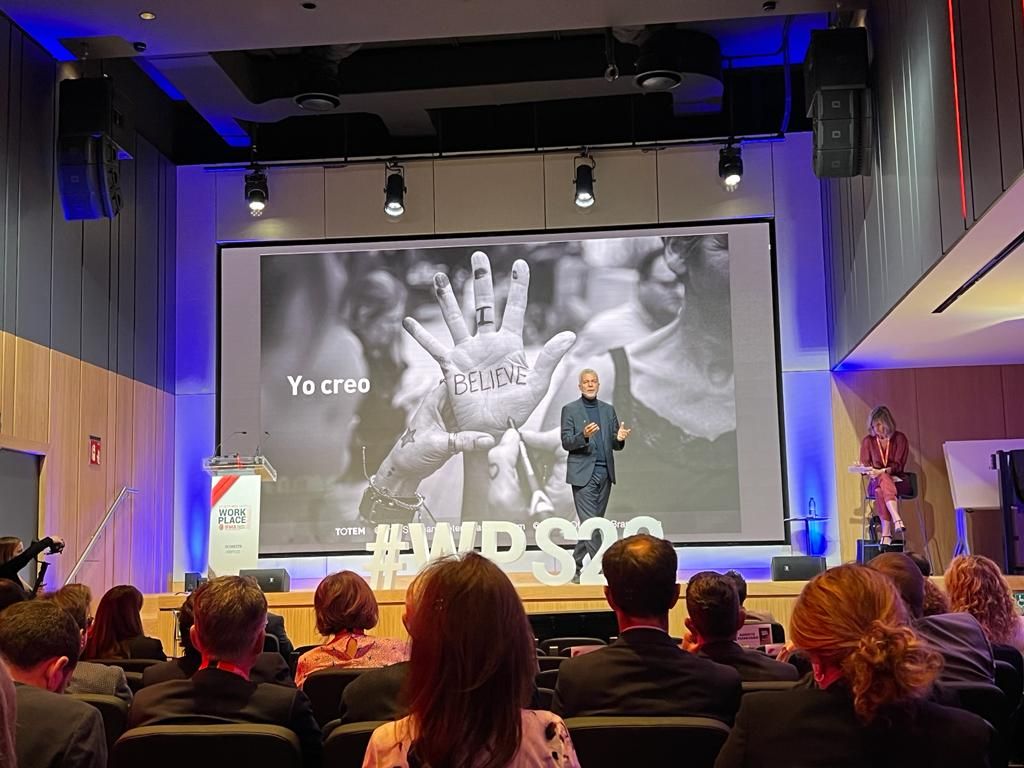
Sharing life, however, isn’t a privilege reserved for large platforms. At TOTEM Branding, we experience it on a human scale. Every 8th of the month, we share our #8HUGS: a small ritual in which we dedicate a hug to a date, a cause, or an emotion. It doesn’t aim for massive reach. It aspires to become a recognizable event for our community. And in our work with brands, we pursue the same goal: helping them move from being customers to becoming believers. Which is another way of saying, helping them move from occupying a space to occupying a place.
Changing the strategic question
This leads me to a reflection that I consider especially important for the future of branding. Perhaps we should complement our obsession with Share of Voice with a deeper question about Share of Life.
How much space does our brand occupy in people’s real lives?
I’m not talking about replacing a conventional metric with a more appealing one. I’m talking about changing the strategic question. Instead of simply measuring how often we appear before someone, we should analyze when we are truly valuable to them.
- What problem are we solving?
- What kind of experience do we provide?
- Which decision do we simplify?
- What ritual are we accompanying?
- What kind of relationship do we make possible?
- And what would happen if our brand disappeared tomorrow?
The proof of the disappearance
This last question is particularly revealing. Because not all brands with a strong presence have a deep connection with people.
An app can be used daily and replaced without much resistance. There’s use there, even Share of Wallet, but not heart.
A company can have millions of customers and not have built any meaningful emotional connection. There’s scale there, but not belonging.
And a relatively small brand can occupy an extraordinarily important place in the life of a community. The neighborhood bookstore, the café where a group of friends meets every Saturday, the sports equipment brand that has been sponsoring a club for thirty years. Little Share of Voice. A huge Share of Life.
If your brand disappeared tomorrow, would anyone miss it or would they simply look for another one?
How to measure Share of Life
Share of Life is not yet a standardized metric, and perhaps it never should be. But six specific indicators can be observed :
- Voluntary and recurring use. Not how many times we impact someone, but how many times they return without us asking.
- Moments and rituals. In what life situations does the brand appear naturally: the morning, the trip, the celebration, the problem.
- Breadth of the relationship. How many different needs does the person trust us with? Share of Wallet provides a valuable clue here.
- Spontaneous recommendation. Who talks about the brand without incentive? This is where Share of Heart comes in.
- Resistance to change. What would have to happen for someone to abandon us?
- Participation. How much the community contributes: ideas, content, criticism, time.
None of these signs, on its own, tells the whole story. Together they paint a picture that no impact report can show: the true place we occupy.
Attention is not connection
The goal, therefore, should not be to be present at all times. It should be to be relevant in those moments when we have a legitimate reason to be there.
A brand that wants to occupy someone’s entire life isn’t looking for relevance. It’s looking for dependency. And that’s not the kind of relationship that builds long-term trust.
Therefore, it is important not to confuse:
- Attention with connection.
- Frequency with preference.
- Spend with loyalty.
- Use with belonging.
- Transactions with relationships.
- Clients with believers.
- Logo with legacy.
A brand can gain fleeting attention with an extraordinary campaign. It needs something much deeper to earn years of trust.
Get back into the relationship
I began by writing that every brand is a relationship and that, in people’s lives, brands are guests. That’s the key to everything else.
A guest who only makes noise is never invited back. One who shows up everywhere uninvited ends up being a nuisance. But one who contributes, listens, respects the house’s rhythms, and appears when truly needed—that one earns a place at the table. And, over the years, a chair with their name on it.
Share of Life isn’t earned. It’s granted. People grant it, every day, to the brands that make their lives a little better.
Brands that matter don’t take up more space. They occupy a place.
I write to you when I have something to tell you.
Get an email every time I publish something new.
Your email will only be used to send you what I publish. Privacy policy
Related posts


