
What is Share of Life and why is it changing how we measure brands?
We went from channel surfing to scrolling in the blink of an eye. And, almost without realizing it, we also began to learn how to build relevant brands in the age of distraction .
Because when everything happens so fast, when everything competes for our attention and when almost any stimulus can disappear with a flick of the finger, the brands that truly leave a mark are the ones that manage to transcend.
I could have ended the post here.
But if you have a little patience, come along. I want to share with you how we got to this point, what we’ve learned along the way, and, above all, how to distinguish between what a brand must change to evolve and what it should never change if it wants to remain recognizable, relevant, and meaningful.
We have multiplied our choices almost infinitely, but not necessarily our capacity to pay attention, understand, or remember. For individuals, this is a challenge. For brands , it’s a matter of relevance, recall, and survival.
We went from channel surfing to scrolling in the blink of an eye.
And it wasn’t just a technological change. It was a cultural and psychological shift, and probably also a profound transformation in how we relate to time, information, and each other.
For many years, the remote control represented a small revolution. It allowed us to decide, change, and abandon what didn’t interest us in order to seek something different. But that universe, seen from today’s perspective, was extraordinarily small.
In Spain, for much of the eighties, national television essentially meant two options: TVE 1 and TVE 2. At the end of that decade, the first private licenses arrived and, at the beginning of the nineties, Antena 3, Telecinco and Canal+ expanded the television landscape.
We went from two major national channels to five. And that seemed like plenty to us.
Today it almost evokes a sense of nostalgia, because channel surfing had something that scrolling has eliminated: an end. We could browse through all the channels and, sooner or later, return to the first one. The universe of choice was limited, visible, and understandable.
Today we can scroll for hours and never reach the end. There is no last video, no last photograph, no last news item, no last opinion, and no last person trying to capture a few seconds of our attention .
The scrolling is infinite.
And perhaps that is one of the most profound differences between the world we left behind and the world we are building. Before, we chose from limited options. Now we live within a virtually unlimited abundance of possibilities.
From five channels to a universe without end
It is worth pausing for a moment to consider the magnitude of the change.
YouTube alone has explained that more than 500 hours of video are uploaded to its platform every minute. That means that while it takes a person sixty seconds to read a few paragraphs of this article, more than twenty full days’ worth of new content has been added to YouTube alone.
And YouTube is just one platform.
To that offering we must add TikTok, Instagram, LinkedIn, X, Twitch, Spotify, podcasts, newsletters, digital media, streaming platforms, WhatsApp groups, Telegram, video games, applications and, increasingly, content generated, multiplied and personalized through artificial intelligence .
We no longer compete against five channels. We compete against virtually everything, all the time. Every brand competes against every other brand, all the time.
The fundamental transformation, therefore, is not that we now have more content. It is that we have gone from a scarcity of options to a saturation of content and an infinite abundance of stimuli.
And our brains haven’t evolved at the same rate as our screens.
The real problem is excess.
For much of human history, having information was an advantage. It had to be found, sought, accessed, preserved, and transmitted.
Today, almost the exact opposite is true. We have too much information. What’s scarce is our ability to decide which information deserves our attention.
That is an extraordinary transformation, because the critical resource of our time is no longer just information. It is human attention , and, probably, after attention, our ability to give meaning to what we pay attention to will become increasingly important .
Seeing doesn’t mean understanding. Understanding doesn’t mean remembering. Remembering doesn’t mean believing. And believing doesn’t necessarily mean acting.
There is a huge distance between appearing before our eyes and occupying a place within our minds.
Brands should understand that distance very well .
What exactly is the attention economy?
The attention economy is based on a very simple idea: human attention is limited, while the number of stimuli competing for it continues to grow. In this context, every platform, company, creator, media outlet, and brand tries to capture a share of this scarce resource.
But today that definition falls short.
It’s no longer enough to simply capture attention. That attention must have a consequence: to generate understanding, recall, identification, conversation, trust, or action.
That’s why perhaps we should also start talking about an economy of meaning . In an environment where everyone can communicate, where everyone can publish, and where generative artificial intelligence radically reduces the cost of content production, the differentiating factor will not simply be producing more, but being able to offer something that has meaning for someone.
Attention is the door.
Meaning is what allows you to build brand relevance .
The eight-second myth
It has been repeated so many times that our attention span is shorter than that of a goldfish that it ended up becoming one of those facts that seem true only because we have heard them many times.
The reality is much more interesting.
There is no single universal figure that determines our attention span. We can remain focused for hours when something fascinates us and abandon a screen in seconds when we’re no longer interested.
However, there are significant signs of how our digital behavior is changing. Researcher Gloria Mark, a professor at the University of California, Irvine, has spent years studying how we manage our attention in front of screens. Her research found that in 2004, people spent about two and a half minutes on the same screen before shifting their focus. In subsequent measurements, that average dropped to approximately 47 seconds.
The data doesn’t mean that humans can only concentrate for 47 seconds. It means that we’ve become accustomed to switching.
And the more we change, the more natural it becomes for us to change again.
Behavior feeds on behavior. Scrolling trains the finger, and the finger ends up training, in part, our expectations.
Everything must arrive quickly. Everything must interest us quickly. Everything must be explained quickly. Everything must excite us quickly. Everything must prove its usefulness quickly.
If he doesn’t succeed, we move on.
We have trained the finger extraordinarily well
Perhaps therein lies one of the most interesting metaphors of our time.
We’ve never been so quick to change when change only requires the flick of a finger. A post loses its appeal, and we move on to the next. A song doesn’t grab us, so we find another. A news story makes us uncomfortable, and an alternative appears. We disagree with someone, and we can unfollow them. A series takes too long to grab our attention, and another immediately takes its place.
We have incorporated change into our daily lives with impressive ease.
But there is a paradox.
We are incredibly fast at changing what’s external. We remain extraordinarily slow when what needs to change is internal.
Changing our minds. Admitting we were wrong. Truly listening to someone who thinks differently. Letting go of a prejudice. Apologizing. Modifying a habit. Questioning a certainty. Reviewing our leadership style. Transforming a company culture. Accepting that what got us here may not be what will take us forward.
For that, a finger is no longer enough.
That’s where the head and the heart must come into play.
And then change stops being easy.
We change a lot. We transform ourselves much less.
This distinction is especially important because we live in a society obsessed with change.
We talk about digital transformation , cultural transformation, organizational transformation, sustainability, and now, transformation through artificial intelligence. Everything seems to be transforming, although we often call what is actually simple replacement “transformation.”
A company changes its software. Has it transformed?
An organization incorporates artificial intelligence. Has it transformed?
A company changes its logo. Has it transformed?
A leader starts posting on LinkedIn. Have they transformed?
A brand incorporates the word “purpose” into its corporate presentation. Has it transformed?
Not necessarily.
Because changing tools is relatively simple.
Changing mindsets is another matter.
You can introduce artificial intelligence into an organization and continue thinking exactly the same way you did twenty years ago. You can digitize all processes and maintain a profoundly analog culture. You can change the logo without changing any behavior. You can talk about innovation and punish anyone who questions the status quo. You can talk about humanity and treat people only as resources.
That’s why changing doesn’t always mean evolving, and moving doesn’t always mean progressing.
How does scrolling affect brands?
Scrolling has radically altered the relationship between brands and people because it has compressed the time available to be perceived, understood , and remembered. A brand no longer competes solely against other brands in its category, but against any content capable of occupying the same screen at the same time.
A campaign can coexist, in just a few seconds, with an international news story, a humorous video, a recipe, a private conversation, an influencer, a song, and a commercial promotion. Everything occupies the same visual space, and everything is just a tiny gesture away from disappearing.
This forces brands to understand that human attention can no longer be taken for granted. But it also demands that they avoid the trap of believing that the only answer is to speed up, simplify, and shout more.
If all brands respond to scrolling by increasing the volume, the consequence will be more noise and less meaning.
The real challenge is to build a brand identity that is clear, consistent, and valuable enough so that, even in a fleeting consumer environment, something remains after the initial impact.
So what happens to brands when it’s all over?
This question should concern anyone responsible for brand building today.
What happens when an extraordinary campaign disappears from the feed a few hours later?
What happens when a company invests months in developing content that the user consumes for seven seconds?
What does it mean to build notoriety in an environment where hundreds of stimuli compete every day to occupy the same mental space?
For a long time, brands aspired to be visible. Then they wanted to be recognizable.
Today they need something more complex. They need to be meaningful.
While not everyone is convinced, visibility can be bought. Relevance cannot.
A campaign can buy millions of impressions. A brand can gain followers. An algorithm can temporarily multiply the reach of content.
But none of those things guarantee that a person will remember why that brand is important to them.
And that’s where a fundamental distinction emerges. There are brands that appear on our screens. And there are brands that enter our lives.
Similar is not the same.
The attention economy is also becoming the forgetting economy.
For years we talked about the attention economy , and it made sense. If there is a limited amount of human attention and a growing number of actors trying to capture it, that attention acquires value.
But perhaps we should add a new concept.
The economy of forgetting .
Because the big problem is no longer just getting someone to see us.
It’s about making something stick after we’ve seen each other. We see a lot and remember far less. And that imbalance will only continue to grow.
Artificial intelligence is radically reducing the cost of content production. We can generate more text, more videos, more images, more campaigns, more personalization, and more versions than ever before.
But when production becomes virtually infinite, attention does not multiply in the same proportion.
We therefore have an extraordinary paradox: the easier it is to produce content, the more difficult it is to produce meaning.
And that’s probably where one of the major frontiers of branding in the coming years will be found.
How can a brand be remembered in a saturated environment?
A brand is remembered when it manages to build consistent associations over time. Not when it surprises once, but when it intelligently repeats what makes it recognizable without falling into monotony.
Brand memory is built when there is consistency between identity, behavior, experience, and communication . When its tone is recognizable. When its values appear not only in a corporate presentation but also in its decisions. When its products, services, spaces, people, and content tell a cohesive story.
Brand building does n’t depend solely on advertising impacts. It depends on the accumulation of meaningful experiences , consistency, and the ability to generate trust, reputation, and a sense of belonging .
That’s why great brands don’t need to constantly reinvent themselves. They evolve, but they preserve their core values. They change, but they maintain their essence. They innovate, but they don’t forget who they are.
In a world where everything changes at enormous speed, brand consistency can also become a form of differentiation .
Appearing is relatively easy. Transcending is extraordinarily difficult.
Visibility can be bought. Attention can be captured. Reach can be amplified. A platform can recommend us. An algorithm can favor us. A campaign can go viral.
But none of that guarantees lasting impact . Because a truly powerful brand is one that resonates in the mind, and in the heart, without needing to constantly appear on screen.
And for that, something much deeper than content is needed. Meaning is needed.
Brands that transcend build associations, codes, experiences, symbols, stories, trust, reputation, community, culture, and brand memory .
That’s why I’ve always found the contemporary obsession with “stopping the scroll” to be limited.
Of course we need to stop him. But that’s only the first battle. The real fight begins later.
What are you going to do with those few seconds of attention that someone decided to give you?
Stopping the finger is useless if we don’t manage to activate the head and the heart
A striking image can stop us in our tracks. A provocative headline can do it. An algorithm can put us in front of millions of people. A celebrity can bring us to the forefront. We can even deliberately manufacture controversy to get attention.
But stopping the finger is not the same as building a brand.
Because branding begins precisely where impact ends.
It begins when what you have communicated starts to relate to something a person thinks, feels, hopes, desires, or remembers.
That is the fundamental leap.
From impact to meaning.
From impression to memory .
From the audience to the community .
From reach to belonging .
From being seen to being chosen.
From appearing to transcending.
When everyone is shouting, perhaps the difference lies in having something to say.
There is another paradox of our time.
As it becomes increasingly difficult to get attention, more and more actors are trying to capture it by turning up the volume.
More headlines, more provocation, more content, more urgency, more frequency, and more stimulation.
And when everyone shouts, the result is not necessarily that we listen more.
The exact opposite can happen. We stop listening.
Brands need to understand that they cannot win this battle indefinitely by increasing volume.
The alternative isn’t always to shout louder. Sometimes it’s to have something worth hearing.
A unique perspective. A recognizable brand identity . An authentic purpose . A consistent brand culture . An extraordinary experience. A story worth telling. A way of behaving that confirms what is promised.
Because when virtually anyone can produce content, content automatically ceases to be a competitive advantage.
Identity can be.
What role will artificial intelligence play in brand building?
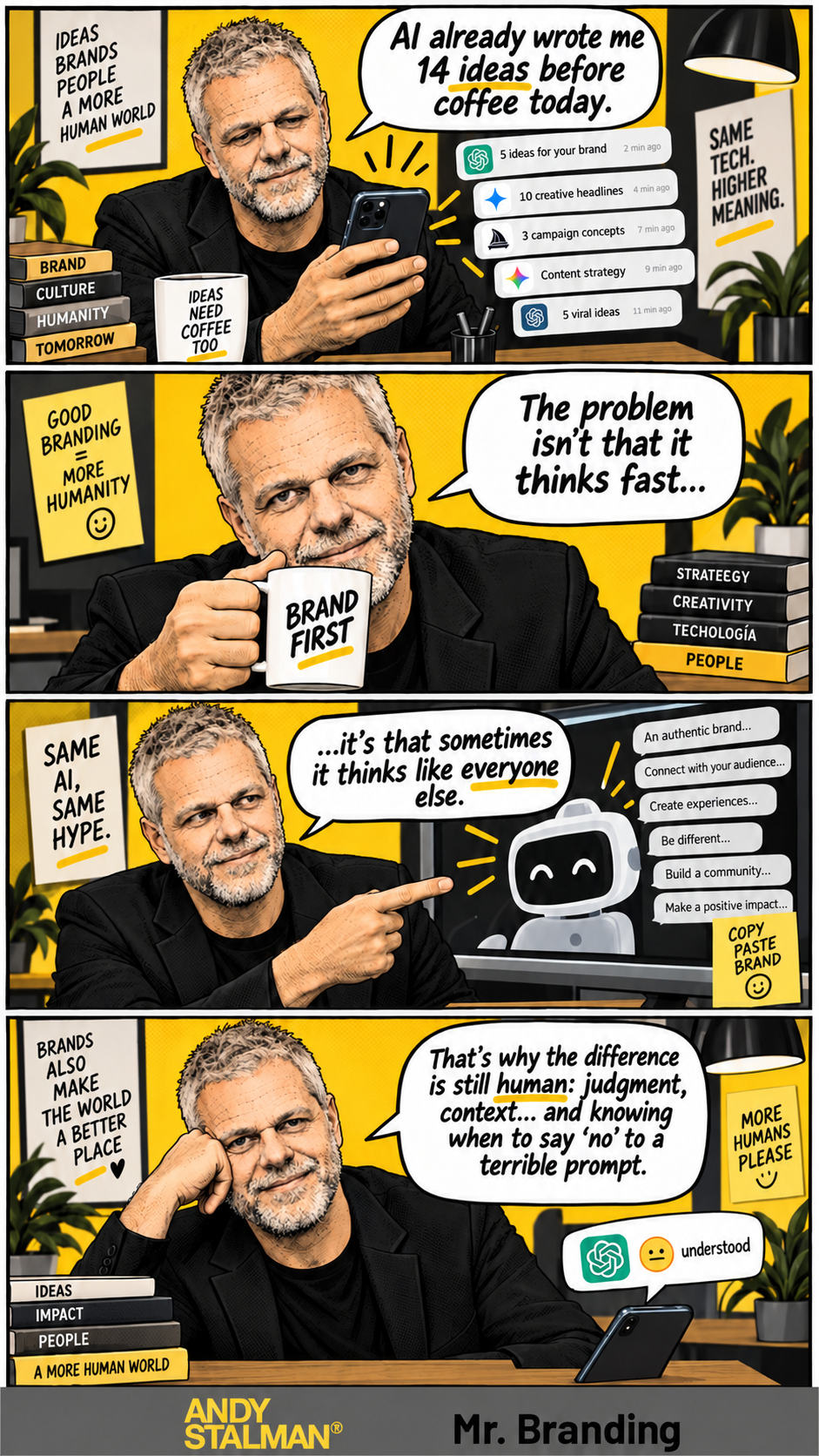
Artificial intelligence will profoundly change how brands research, create, personalize, analyze, and distribute content. It will allow them to test more ideas, generate more variations, better understand certain behavioral patterns, and accelerate processes that previously required significantly more time and resources.
But precisely for that reason, the value of what AI cannot define on its own will increase: criteria , brand identity , brand culture , consistency , and meaning.
Artificial intelligence can help us produce faster, but it cannot decide on its own what deserves to exist or what a brand should represent.
It can help us optimize a message, but it shouldn’t replace the fundamental question of any brand strategy : why do we want to say it?
It can multiply possibilities, but someone has to select. It can accelerate processes, but someone has to decide the direction. It can generate content, but it shouldn’t be the one defining what an organization believes in, stands for, and represents.
In that sense, one of the biggest risks of the relationship between AI and brands will not only be automation, but homogenization.
If all organizations use similar tools without having a sufficiently strong brand identity , many will end up looking too much like each other.
The more the capacity to produce is democratized, the more important the ability to differentiate, connect, and transcend will be .
AI will multiply the content. That’s why we’ll have to multiply our critical thinking.
We are only just beginning to understand the impact that generative artificial intelligence will have on this ecosystem.
Where producing a campaign previously took weeks, certain pieces can now be produced in hours. Where generating a hundred variations was once unfeasible, tomorrow thousands will be possible. Where our production capacity was once the limit, that limit is beginning to disappear.
And that will have an inevitable consequence.
There will be more videos, more text, more images, more ads, more messages, more personalization, more recommendations, and also more noise.
That’s why I believe that a fundamental part of the future of brands will not be in their ability to produce.
It will be within their power to choose what deserves to be produced.
AI can generate, but the criteria must select.
AI can multiply, but brand strategy must bring order.
AI can optimize, but identity must decide.
AI can help us get attention, but we still need to know what we want to do with it.
Brands are also scrolling over themselves
There is also another problem that we talk about less: it’s not just individuals who are trapped in the logic of scrolling; many organizations are too.
One trend replaces the previous one. One buzzword replaces another. Metaverse, Web3, NFT, purpose, sustainability, artificial intelligence, agents.
Constant novelty can create the feeling of moving forward when, in reality, many companies are simply scrolling over their own strategy.
Today they adopt one trend and tomorrow they run after the next, without giving either one enough time to understand it, integrate it and turn it into a real advantage.
But a brand isn’t built that way.
A brand needs evolution, but also continuity. It needs to adapt without losing its essence. It needs to change without forgetting who it is. It needs to incorporate new tools without surrendering its identity.
Because if a brand changes every time the algorithm changes, it will end up belonging to the algorithm and not to itself.
Memory will become increasingly valuable
Perhaps that’s why brand memory will become one of the most important assets of organizations.
A brand is, to a large extent, what remains.
It’s what someone remembers when the ad ended, what they feel when they hear the name, what they expect before entering a store, what they recount after experiencing something, what they recommend, what they forgive, and also what they are unwilling to forgive.
Brands would be able to answer clearly the question: what do we want people to remember?
Not just tomorrow, but years from now.
What do we want to represent?
What do we mean?
What place do we want to occupy?
What kind of brand impression do we want to leave?
Because strong brands are not only those capable of generating millions of impressions.
They are those capable of turning some of those impacts into memory.
And memory, when accompanied by emotion, coherence, and experience, becomes meaning.
From channel surfing to scrolling. From scrolling to awareness.
Perhaps therein lies the great metaphor.
Channel surfing taught us that we could change.
Scrolling taught us that we could change permanently.
Now we will have to learn something much more difficult: knowing when not to change.
Knowing when to stop, delve deeper, listen, discern, and choose. Knowing when to maintain a conviction when it deserves to be maintained and having the courage to change it when it no longer makes sense.
Because not everything new is better.
Not everything that is fast is progress.
Not everything that is visible is relevant.
Not everything that goes viral is important.
Not everything that gets attention deserves to be remembered.
And not everything that happens leaves a mark.
Perhaps the great challenge of our time is not to make our finger move even faster.
We’ve trained him well enough already.
The real challenge will be to ensure that our mind and heart are able to keep pace with a world that accelerates relentlessly, without allowing that speed to rob us of the ability to think, feel, understand, and choose.
Brands will also have to decide.
They can continue trying to appear more and more often on our screens, or they can aspire to something much more difficult and much more valuable: to connect, to be relevant, and to transcend .
Because when everything passes (because life, too, is about passing), transcending (leaving a path) is an advantage.
When everyone is talking, having something to say is an advantage.
When everyone is producing, having good judgment is an advantage.
When everything is speeding up, knowing when to stop is an advantage.
And when technology allows you to do almost anything, knowing who you are, what you stand for, and why you should matter to someone can become the greatest advantage of all.
We went from channel surfing to scrolling in the blink of an eye. We went from five channels to virtually infinite possibilities, from the remote control to the algorithm, from searching for something to watch to constantly receiving something new to watch, and from a scarcity of content to a scarcity of attention.
Now perhaps one step is missing, an inward step, towards oneself; moving from scrolling to awareness.
Because moving your finger is easy. Changing your mind is difficult, and moving your heart is even harder.
And making a brand leave a mark when everything else disappears with the next scroll will be one of the great challenges of branding , the attention economy , and the relationship between artificial intelligence and brands in the coming years.
I write to you when I have something to tell you.
Get an email every time I publish something new.
Your email will only be used to send you what I publish. Privacy policy
Related posts


