

What is Share of Life and why is it changing how we measure brands?
“In our time there is no such thing as ‘staying out of politics.’ All issues are political issues, and politics itself is a mass of lies, evasions, nonsense, hatred …” Eighty years ago, George Orwell wrote something that remains remarkably relevant today. In his essay “Politics and the English Language ,” published in the British magazine Horizon , he described politics as an accumulation of lies, evasions, nonsense, hatred, and contradictions. Any resemblance to the present day is not mere coincidence.
What’s unsettling about that reflection is that Orwell was writing about the power of language long before the internet, social media, or artificial intelligence existed. He had understood that the way we use words conditions our ability to think , interpret reality, and relate to the truth.
Eighty years later, his warning takes on a dimension he could hardly have imagined.
What would Orwell have thought if he had known that one day we could fabricate the voice of a president, recreate a speech that never existed, produce images of events that never happened, or fill social media with thousands of fictitious citizens passionately defending a political cause?
And, above all, what would he have thought upon discovering that much of that content could be produced in a matter of seconds, practically at no cost and with an extraordinary capacity for dissemination?
The question is both fascinating and disturbing to me.
We are living through one of the most important technological transformations in history. Artificial intelligence is expanding our possibilities for learning, researching, creating, and solving extraordinarily complex problems. Its potential excites me.
That is precisely why I am concerned about the poor use that, on too many occasions, we are making of such powerful tools.
We have developed systems capable of accelerating scientific research and facilitating access to knowledge, while a part of our digital production is dedicated to manufacturing absurd images, misleading videos, fabricated statements, and publications designed to provoke an immediate reaction.
What Orwell identified as a deterioration of political language is finding new possibilities for expansion today through technology.
Manipulation can take on the appearance of reality. Political propaganda can multiply automatically. A lie can circulate accompanied by images, voices, and testimonies that seem to confirm it.
And there is something even more worrying because we can end up getting used to living with that uncertainty.
To systematically suspect what we see. To distrust what we hear. To accept as true what confirms our convictions without taking the time to verify it.
In this context, the elections in Brazil, the United States, Israel, and Spain take on special significance. In the coming weeks, millions of citizens will participate in democratic processes while content generated by artificial intelligence occupies an increasingly prominent place in the political discourse. At the beginning of 2027, El Salvador will also hold presidential and legislative elections, extending a particularly important electoral cycle.
Different countries, different realities and a shared challenge: preserving the quality of public debate in an environment where fabricating appearances is becoming increasingly easy.
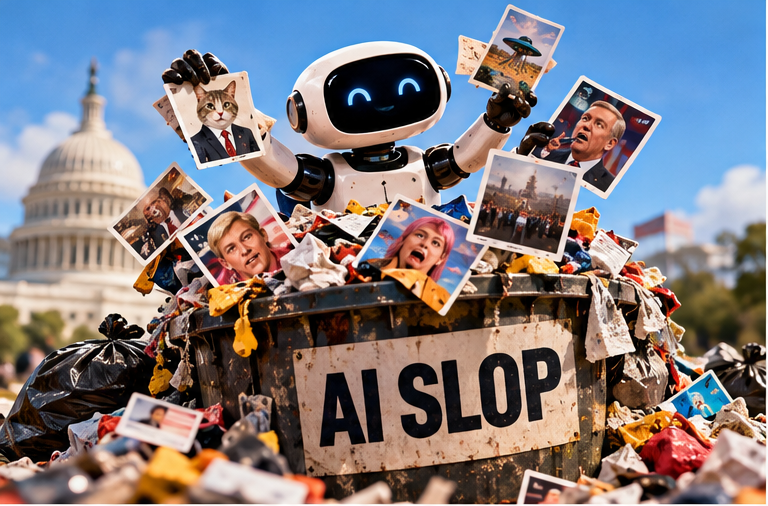
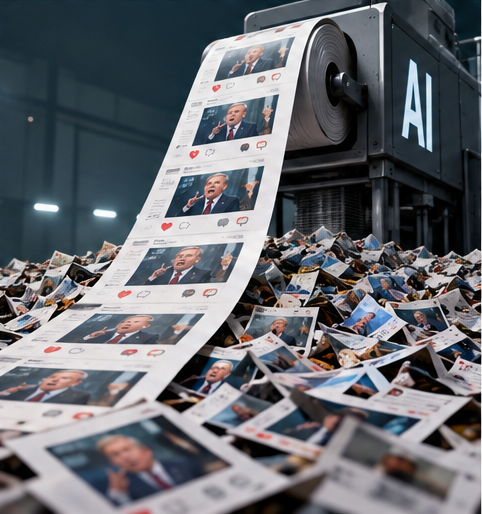
The phenomenon has a name that is beginning to spread throughout the digital ecosystem: AI slop . In other words, digital garbage. Synthetic garbage.
An expression that describes the proliferation of content that is low value, repetitive, superficial, and mass-produced using generative artificial intelligence .
The name might seem provocative. But what it reveals prompted me to write this post, to share this reflection with you.
Because we are entering a stage where the abundance of content can end up obscuring precisely what we need most to understand the world: reliable information, critical thinking, and trust .
And when that dynamic is transferred to politics, the consequences cease to be limited to our screens.
What is AI slop and why is it a concern in the 2026 elections and beyond?
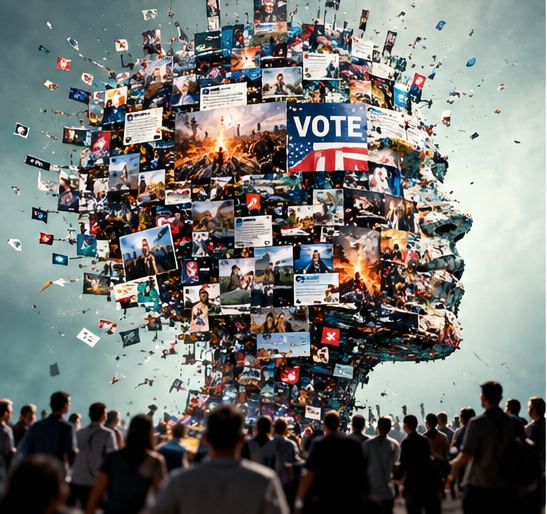
The proliferation of synthetic content, deepfakes , and AI-generated propaganda poses a challenge that extends beyond the upcoming elections. In a society where it is increasingly easy to fabricate appearances, the trust, reputation, and credibility of political brands take on crucial importance.
The concept of AI slop describes an increasingly visible consequence of the democratization of digital creation tools: the possibility of producing virtually unlimited amounts of content without any correspondence between that volume and its value.
The problem deserves attention because it affects a transformation that we are still trying to understand.
For much of media history , producing and distributing content required resources, specialized knowledge, infrastructure, and time. These barriers also limited the diversity of voices and concentrated the power to communicate in the hands of certain actors.
Digitization began to profoundly alter that reality. The internet allowed millions of people to publish, share, and access information in a radically different way.
Generative artificial intelligence is accelerating that transformation to levels that recently seemed unimaginable.
Today we can generate images, videos, texts, voices, and audiovisual representations using relatively simple instructions. We can translate, transform, adapt, and multiply content with extraordinary speed.
From a creative and technological standpoint, we have an immense opportunity. However, the ease of production also reduces the incentive to stop and think, to research, to compare, to develop our own ideas, and to decide whether what we’re going to share truly offers something to the recipient.
The digital ecosystem is beginning to show the consequences of that tension.
Nearly identical posts. Seemingly spectacular images that we forget seconds later. Videos designed using repetitive structures. Headlines that aim to provoke outrage. Opinions fabricated to fill the available space in a conversation.
And, gradually, a feeling of saturation that can end up weakening our relationship with information.
waste generated by artificial intelligence represents a new dimension of a broader cultural problem : our difficulty in managing abundance.
In politics, this abundance finds particularly sensitive ground. An election campaign should allow citizens to learn about proposals, compare track records, understand priorities, and evaluate different visions for the country.
But when public discourse is filled with materials designed primarily to grab attention, content that requires time, context, and reflection may find it more difficult to become visible.
Democracy needs a citizenry capable of making informed decisions. And that capacity is closely linked to the quality of the information environment in which we live.
Deepfakes and political propaganda in the age of artificial intelligence
manipulation has a history much older than the internet .
Propaganda (not to be confused with advertising), exaggeration, smear campaigns, and the self-serving use of language have accompanied different political systems for generations.
Orwell observed it from the perspective of his time. We are witnessing a transformation of the tools available to carry out these practices. The most evident difference lies in the scale, scope, and impact.
Today it is possible to create synthetic versions of real people, modify audiovisual statements, invent scenes and distribute countless variations of the same message.
Political deepfakes are one of the best-known manifestations of this phenomenon. Using artificial intelligence techniques , it’s possible to generate or alter audiovisual content to depict a person saying or doing something that never happened.
These technologies can also be used legitimately in artistic, educational, or satirical contexts. Their mere existence does not make any artificial content a form of manipulation.
The crucial issue arises when the synthetic representation is presented in a way that can lead to confusing it with a real event.
US midterm elections of November 2026, the presence of political ads generated or modified with artificial intelligence has acquired a considerable dimension.
Wesleyan Media Project investigation had identified, in early September, at least 164 advertisements incorporating these technologies, associated with an investment of nearly $80 million. By mid-October, the figures compiled and disseminated by various media outlets had already exceeded 200 advertisements and $100 million.
These figures illustrate the speed at which artificial intelligence is being used in political advertising. It’s important to clarify, however, that these are ads generated or modified using AI, and their identification does not necessarily mean they were all deceptive.
In Spain , the situation also deserves attention.
In October, Maldita.es documented the circulation of AI-generated videos showing alleged irregularities related to postal voting before the general election on November 29.
Some of this content was identified as fabricated or presented as humor and satire. However, the scenes could reinforce narratives of election fraud when circulated on social media and messaging services.
This introduces a particularly relevant issue.
A false representation can trigger genuine emotions. A fabricated scene can reinforce existing suspicions. And a post initially presented as a parody can take on different meanings when shared outside its original context.
In Brazil, electoral authorities have developed specific rules to address certain deceptive uses of artificial intelligence during campaigns.
Israel also faces concerns related to manipulated images, artificial profiles, and the automation of political messages.
The institutional and social contexts of these countries are different. Nor do we have sufficient evidence to claim that artificial intelligence alone will determine election results.
However, the examples show how electoral disinformation and synthetic content are acquiring an increasingly relevant presence in political communication.
And its potential effects extend far beyond a single vote.
When false information erodes trust in reality
There is another dimension to this phenomenon that also worries me.
Artificial intelligence is changing a relationship that we have long considered relatively stable; the one that exists between an image and what it represents.
Photographs and audiovisual recordings could be manipulated long before the advent of current generative models. But the sophistication and accessibility of these new tools have significantly increased the possibilities for alteration.
The result is a growing uncertainty about the authenticity of some of the materials circulating in the digital environment.
And that uncertainty has a second consequence.
If any video can be a fake, an authentic video can also be presented as fake.
If we can clone a voice, a real statement can be denied by attributing it to a simulation.
If we can fabricate convincing images of non-existent events, the existence of such tools can also be used to discredit real evidence.
Researchers call this phenomenon the liar’s dividend .
The concept describes the advantage that can be gained by those who seek to deny real facts by taking advantage of the uncertainty generated by manipulation technologies.
I think it’s one of the most profound threats to the future of public discourse.
Because a democratic society can coexist with radically different opinions. It can debate economic projects, values, public policies, and ways of understanding the world.
Disagreement is part of their nature.
But it becomes much harder to build a conversation when a minimal base of verifiable facts disappears. When all evidence is suspect. When each group ends up relying exclusively on sources that confirm its own beliefs. When the interpretation of reality depends increasingly on our political identity and less and less on our willingness to verify information.
Distrust in democratic institutions can be fueled by this process, especially when the circulation of misleading content reinforces perceptions of manipulation or illegitimacy.
And here appears another (and there are many) disturbing paradox.
The same technologies that can extraordinarily expand our access to knowledge can also facilitate an environment where it is more difficult to recognize what deserves our trust.
Political branding and reputation in times of AI slop
I have dedicated more than thirty years of my professional life to working with brands, institutions and organizations from different countries, cultures and industries.
That experience has allowed me to understand the extent to which trust is one of the most valuable assets an organization can build.
Brands acquire meaning through an accumulation of experiences, decisions, behaviors, and relationships. Communication is part of that process, but reputation ultimately reveals the consistency between what an organization promises and what it actually does.
This reflection takes on a particularly interesting dimension when we talk about political branding .
A political party possesses a recognizable identity. It represents values, aspirations, ideas, and specific societal projects. It builds emotional connections and generates expectations among those who support it, question it, or simply observe its behavior.
The same applies to candidates and public institutions. They are all brands.
But political brands have a fundamental difference. Their decisions and messages can affect society as a whole more directly. Therefore, their responsibility transcends the traditional objectives of marketing and communication.
The proliferation of AI slop introduces a familiar temptation in the world of branding: confusing visibility with relevance. A campaign can achieve millions of views without having helped people better understand its message.
It can dominate a conversation for days and leave a negligible mark on the collective memory. It can generate enormous immediate notoriety while undermining the credibility of those involved. The difference between these outcomes deserves in-depth analysis.
In the digital environment, we have developed extraordinarily sophisticated mechanisms to measure reach, views, interactions, plays, and audience growth.
These indicators are useful, but incomplete. They allow us to know how much a message circulates, but they don’t always explain how it is interpreted, what meaning it acquires, or what consequences it has on the relationship between an organization and people.
A relevant political brand needs to build a recognizable identity and a coherent relationship with the citizenry.
Your reputation will depend on what you communicate, how you behave, and the experience you generate when you have to assume responsibilities.
Artificial intelligence amplifies organizations’ communication capabilities. It can also amplify the contradictions between their discourse and their actions.
And in an environment where appearances will become increasingly easy to manufacture, these contradictions may take on even greater importance.
The algorithm and the temptation to produce without rest
Political communication is currently developing in an ecosystem where digital platforms occupy a fundamental place.
Recommendation systems influence the content we see, the conversations we access, and the sources that are part of our information diet.
Generative artificial intelligence allows these systems to be fed with extraordinary amounts of content. A single message can be transformed into multiple videos, images, texts, audios, and formats tailored to different audiences. From an operational perspective, this capability is truly impressive.
However, it’s worth asking ourselves what kind of incentives we’re reinforcing when we use these tools to constantly expand our digital presence. Public affairs are often complex. Housing, education, pensions, healthcare, immigration, technological transformation, taxation, and security all require knowledge, context, and the ability to recognize different perspectives.
Decisions that affect millions of people can hardly be fully understood through a series of stimuli designed to elicit an immediate reaction. This doesn’t mean, however, that short formats are without value.
The ability to explain a complex idea simply is an extraordinary virtue. A good summary can help people understand issues that would otherwise be inaccessible to many.
But behind that synthesis there must be thought. Research. Judgment. A sufficiently deep understanding of what we intend to explain.
overload on social media can foster a communication culture where content is valued primarily for its ability to circulate.
And that logic risks displacing the questions that should guide any communication strategy: What do we want to contribute? What meaning does what we share have? What kind of relationship are we building with people? What consequences might our messages have when they leave the context in which they were created?
The AI slop finds particularly fertile ground in a culture obsessed with speed and constant production.
Perhaps one of the most important decisions that organizations will have to make in the coming years is to regain the ability to select what deserves their attention and resources.
The risks of artificial intelligence in election campaigns
The expansion of artificial intelligence in electoral processes poses challenges that affect both citizens and institutions.
Manipulation through political deepfakes can generate false representations of candidates, leaders or citizens, attributing to them words and behaviors that never existed.
The mass production of misleading content can contribute to saturating the public conversation, making it difficult to identify reliable sources and displacing relevant debates.
The use of bots and fake profiles introduces the possibility of simulating popular support, artificially amplifying certain narratives, or generating a distorted perception of consensus.
Also worrying is the premature circulation of claims about alleged electoral fraud, especially when synthetic content is used to reinforce suspicions about democratic procedures before there are facts to justify them.
Another major risk affects women involved in politics, who are exposed to specific forms of digital violence through artificial intelligence , including identity theft, sexualized montages, and harassment campaigns.
Conversational assistants can also become a source of confusion if they offer incorrect election information about dates, procedures, requirements, or institutions.
The impact of these phenomena will depend on numerous factors: the political context, existing norms, media literacy, verification mechanisms, the behavior of platforms, and the willingness of citizens to verify information.
It would be a mistake to attribute to artificial intelligence an automatic capacity for manipulation that still requires research and evidence.
But it would also be irresponsible to ignore how these technologies can facilitate deceptive practices and expand their reach.
The issue requires a rigorous, proportionate approach that is aware of its implications for freedom of expression and democratic participation.
How should political parties use artificial intelligence?
I believe that the incorporation of artificial intelligence into political communication offers an extraordinary opportunity to review some practices and develop a more mature relationship between technology, leadership, and citizens.
The possibilities are enormous. And of course, every match is different.
But taking advantage of them requires strategic decisions and commitments that go beyond simply adopting new tools. And it requires a deep understanding of the brand itself to determine whether what comes next aligns with its values.
A primary responsibility is to establish clear criteria for transparency, authenticity, and traceability .
Parties should properly identify synthetic content that could be mistaken for real representations, especially when it includes images or voices of existing people.
They should also establish explicit commitments against deceptive impersonation and provide mechanisms to verify the origin of their official materials.
Digital authenticity standards can help, although their presence or absence should never be considered definitive proof of truthfulness.
A second responsibility has to do with listening to citizens .
Artificial intelligence offers extraordinary capabilities to analyze public inquiries, organize proposals, facilitate translations, improve accessibility, and help understand concerns shared by different sectors of society.
I would like to see more political organizations using these tools to enrich their listening and understanding processes.
Naturally, these applications require human supervision, protection of personal data, and mechanisms to reduce errors or biased interpretations.
The third responsibility is related to the quality and depth of the proposals.
I would like the campaigns to dedicate more resources to explaining how certain measures will be financed, what difficulties might arise, what their limitations are, and what consequences they may have for different sectors of society.
AI can facilitate that process through accessible content, interactive summaries, and different levels of explanation.
But the value of those applications will depend on the quality of the ideas and the information that supports them.
A fourth responsibility is to develop protocols against electoral disinformation .
Parties and candidates should have procedures in place to identify falsified content, communicate verifiable denials, preserve original materials, and collaborate with independent organizations where appropriate.
Internal training will also be essential. Many misleading posts can be amplified by people who share them in good faith, without verifying their authenticity.
The fifth responsibility concerns consistency. Political brands should be able to demonstrate a recognizable link between their public pronouncements and their actions. If an organization speaks of transparency, its own practices should reflect that commitment. If it demands respect, its communication should live up to that principle. If it champions accountability, it should show a willingness to acknowledge mistakes and take responsibility for the consequences of its decisions.
Artificial intelligence can significantly enhance a party’s communication capabilities. However, the credibility it manages to build will depend on the conduct of its representatives and the consistency of its commitments.
Finally, I think we should re-evaluate how we measure the success of a campaign. Does only the winner win?
Reach and engagement metrics offer valuable information. However, it would be desirable to incorporate indicators related to the understanding of the proposals, public trust, credibility, and the quality of public debate .
These dimensions are more difficult to measure and their results require time. Precisely for this reason they deserve greater strategic attention.
The future of political branding and verifiable authenticity
There’s one word that keeps popping up in conversations about branding, leadership, and communication: authenticity.
We use it so much that, at times, it seems to have lost some of its meaning. “Todo/s?” wants to sound authentic.
Organizations want to appear approachable. Leaders aspire to convey spontaneity. Brands seek to project transparency and humanity.
Meanwhile, technology is making it increasingly easy to construct convincing appearances.
We can recreate informal conversations, modify facial expressions, adapt voices, and generate scenes capable of conveying specific emotions. The appearance of authenticity is becoming technically reproducible.
And that transformation should make us reflect on the meaning we give to the word.
In my experience, the most relevant brands build relationships through their behaviors and the experiences they generate.
An organization can claim to value its customers, but that promise only truly matters when someone needs help and experiences how it responds. It can talk about innovation, sustainability, or social commitment, but its credibility will depend on what it can actually demonstrate.
with political brands , although the responsibility is much greater.
Their authenticity is tested in the exercise of leadership, accountability, management of public resources, respect for institutions, and the way they relate to those who hold different opinions.
Artificial intelligence is ushering in a new era in which these dimensions can acquire extraordinary relevance.
When the ability to manufacture images, discourses, and representations becomes virtually universal, differentiation based exclusively on the quality of production will become increasingly less sustainable.
The credibility of political leaders will be closely linked to the ability to verify their claims, understand their decisions, and evaluate their behavior. This presents an opportunity for those working in political branding.
An opportunity to reclaim the importance of identity, culture, values, and lasting relationships. To develop narratives supported by understandable proposals and recognizable commitments.
And to understand that the true value of a brand is manifested in what it means to people over time.
Political reputation is also decided after the elections
There is one issue that I find particularly important and that often receives less attention than it deserves.
What happens to trust when an election campaign ends? What happens the day after?
The citizens will have voted. The results will be known. The advertisements will gradually disappear from the screens. News priorities will change.
However, the consequences of the communication used during those months can linger for a long time. A campaign based on systematic denigration can deepen divisions that later prove difficult to manage. Excessive promises can generate expectations that no administration is capable of fulfilling.
Misleading narratives about institutions can erode their legitimacy even when those who spread them later have to work within them. Politics has a particular characteristic worth remembering: those who assume government responsibilities must also answer to those who did not vote for them.
They will have to manage differences, explain decisions, negotiate, and engage with a pluralistic society. And those who remain in the opposition will continue to play an indispensable role in the functioning of democracy.
From the perspective of branding and political reputation , this is one of the biggest risks of exclusively prioritizing immediate results.
An organization can develop an extraordinarily efficient campaign to capture attention and then discover that it has damaged some of the trust necessary to fulfill its responsibilities.
Reputation has a cumulative dimension. Every message, every decision, and every behavior contributes to shaping a perception that can last much longer than the campaign that originated it.
Therefore, I would like political communication professionals to incorporate an additional question into their evaluation processes.
What kind of relationship with society will this campaign be building when the elections are over?
The answer could change many strategic decisions.
Democracy facing the challenge of synthetic content
We are developing technologies capable of dramatically expanding our capabilities. Artificial intelligence can improve access to knowledge, facilitate participation, help us understand complex problems, and open up opportunities we are only beginning to imagine.
It can also be used to multiply misleading content, fabricate appearances, and fuel information overload.
Both possibilities are part of the same technological landscape. And the decisions we make will largely determine their consequences.
The upcoming elections will be an opportunity to observe how parties, candidates, platforms, media outlets, and citizens react to these challenges. It would be naive to think that we can completely eliminate propaganda, manipulation, or disinformation.
Nor would it be desirable to adopt indiscriminate responses that end up restricting freedom of expression or confusing legitimate satire with deliberately deceptive practices.
We need independent verification mechanisms, media education, transparency, proportionate criteria, and clear responsibilities.
But there is one dimension that no regulation can fully resolve: the communication culture we are building. Our willingness to verify information that confirms our own ideas. The importance we place on reflection versus immediacy. The ease with which we share content without questioning its source. The way we react to differing opinions.
And our tendency to confuse what generates an intense reaction with what truly deserves our attention.
The AI slop finds fertile ground in that culture of acceleration.
Artificial intelligence has dramatically lowered the barriers to content production. Now we need to develop better criteria for deciding which content deserves to be created, shared, and amplified.
And that reflection should involve us all.
The mark we will leave
I like to think that major technological transformations end up making us ask questions about ourselves.
The internet has radically expanded our possibilities for connection. Social media has changed how we relate to each other, access information, and construct identities. Artificial intelligence is beginning to transform capabilities that until very recently we considered exclusively human.
Each of these revolutions has opened up extraordinary opportunities and highlighted contradictions that already existed in our society.
AI slop and political disinformation are some of the most visible expressions of these contradictions .
We have extraordinarily powerful tools, and sometimes we use them with disconcerting superficiality.
We can access immense amounts of knowledge and yet we remain vulnerable to messages that confirm our biases.
We have technologies capable of bringing cultures, languages and perspectives closer together, while part of the public conversation seems organized around permanent confrontation.
In this context, the upcoming elections have a relevance that transcends the results in each country.
They will also test our ability to preserve spaces for shared conversation in a society where producing appearances will become increasingly easy.
I believe in the possibilities of technology and in the human capacity to use it in a creative, responsible and transformative way.
That’s why I’m worried that such an important part of our political conversation will end up becoming an endless succession of synthetic stimuli.
Societies evolve thanks to knowledge, cooperation, debate, the ability to imagine different futures, and the efforts of people who turn those aspirations into realities.
Brands also acquire meaning through this process: through the relationships they build, the experiences they create, the commitments they uphold, and the impact they have on people.
Political brands have a particular responsibility because they participate in building something that belongs to everyone: our common life.
In a few years, we will remember who won certain elections. We will also be able to study how artificial intelligence influenced those campaigns.
But I would like us to be able to look back and recognize that this moment served to develop a more mature relationship with technology, information, and democracy.
We learned to use extraordinary tools with greater discernment. We understood the value of trust when it was becoming increasingly fragile. We knew how to preserve the right to disagree about our ideas without losing respect for facts and for people.
I return then to Orwell and to that reflection he wrote eighty years ago.
In his essay, he warned about the capacity of political language to distort our relationship with the truth. He also understood that there is a profound relationship between the quality of the words we use and the quality of our thinking.
Today we are taking another step.
We have developed technologies capable of fabricating words, images, voices, and scenes that can be mistaken for reality. We are building an ecosystem in which appearances multiply while attention fragments and trust becomes increasingly difficult to earn.
The question we should be asking ourselves is what will happen when disinformation generated with artificial intelligence reaches an even larger scale.
When an authentic statement can be immediately dismissed as a fabrication. When a forgery spreads faster than any possibility of refuting it. When information overload causes a portion of the public to stop trying to distinguish truth from fiction.
That would be one of the most serious failures of our relationship with technology.
Because trust constitutes an invisible infrastructure upon which our relationships, our institutions, and our ability to build collective projects rest.
We can rebuild a campaign. We can change a strategy. We can modify a message or replace a technology.
Rebuilding trust in a society that has learned to distrust everything is an infinitely more difficult task.
And here, in my opinion, lies the true magnitude of the challenge.
The upcoming elections will determine governments, representatives, and political projects. But they will also reveal what place we are willing to give to truth in a society capable of producing endless versions of reality.
Artificial intelligence will continue to advance. Its capacity to generate content will grow. Simulations will become more convincing, and the boundaries between the authentic and the artificial will continue to raise new questions.
Our responsibility will grow with them.
Because when a society loses the ability to distinguish facts from fiction, it also begins to lose the freedom to decide on its own future.
And that is a price no democracy should be willing to pay.
I write to you when I have something to tell you.
Get an email every time I publish something new.
Your email will only be used to send you what I publish. Privacy policy
Related posts


